South Africa – May 2017
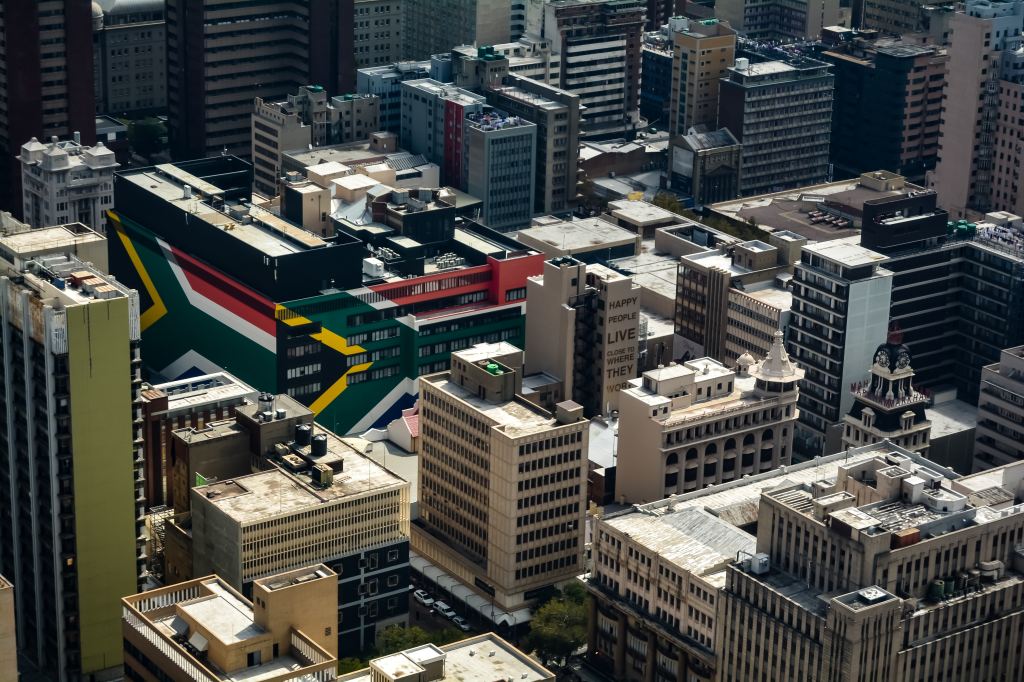
Johannesburg is the start of mine and Tina’s journey together in South Africa. Here we visit some of my distant relatives before flying south and embarking on the road trip along the Garden Route. Nadja – my mother’s 2nd cousin – picks me up at the airport in Johannesburg when I land on the plane from Kruger National Park. Tina arrived a few hours earlier and is already waiting at Nadja and her boyfriend Mark’s house. We pass the barrier at the entrance to the secured complex where they live and I meet the cat directly at the apartment door.

After a small house tour Mark serves us a typical South African barbecue and we go to bed early. The next day we want to see Pretoria. Read more about the trip to South Africa’s capital in the separate blog post. The following day Nadja’s brother, Roland, picks me and Tina up. His part of the family also wants to meet us. We first go to the Apartheid Museum, which deals with a particularly dark chapter in South Africa’s history.

The entrance to the museum is already moving and ensures that all visitors are immediately in the middle of the topic. As tickets, each person is randomly given a piece of paper that translates as “white” or “non-white. Depending on the slip, one has to go down a different aisle. The example illustrates the politics of racial segregation in South Africa. Under this political system in the 20th century, the black part of the population was oppressed and discriminated against by the white part of the population.
In 1910, the newly formed Union of South Africa enforced two laws that discriminated against citizens with dark skin and made them lower class people: Blacks were allowed to perform only menial labor (i.e., simple but often physically strenuous jobs that did not require specialized knowledge) and to live only in certain areas. Outside the enacted areas, they were forbidden to buy land.

But although apartheid officially ended in South Africa in 1994, its painful consequences can still be felt in society today. Just because racial segregation has been politically abolished, it has not yet disappeared from people’s minds. This is exactly why places like the museum in Johannesburg are incredibly important. Only through education can the chance of the past being repeated be reduced.

After the museum visit, we drive back out to the suburbs of the city to Roland’s home. When we arrive at the large piece of land, it is clear to see which side of history my relatives were on. The neat two-story brick house is not surrounded by a high fence (like Nadja’s complex), but by a spacious garden with a pond and geese. For dinner we have a stew with pumpkin and, of course, grilled meat with it.

We eat early because Roland’s voluntary spinning class starts at 7:00 pm. Tina and I don’t have any sportswear in our luggage. Nevertheless, we set off to pedal hard for 1 hour on the home trainers in the converted barn with the entire elderly neighborhood. Most of the seniors are far fitter than we are, and soon we are just watching from the corner, panting.
When the training is finally finished and we are freshly showered, we later meet Roland and his wife in the living room. He proudly shows us the wooden family coat of arms (Gaberthuel – my mother’s former last name) and tells us about his time in the recruit school of the Swiss army. It was there that Roland learned Swiss German and 30 years later he still has a pretty good command of the language. In a gibberish of German and English, he reminisces about childhood visits to his father’s homeland.

Later we sit together in his converted Landrover and Roland tells us about his dream of traveling in the expedition vehicle through the entire African continent and on to Asia and Europe. Full of new impressions we fall asleep quickly that night. The next day Roland shows us his workshop, where his meanwhile grown-up children Roland Jr. and Kristin also work. For Tina – herself a trained design engineer – it is particularly exciting to see how differently her profession is practiced in South Africa.

Before lunch it is unfortunately time to say goodbye. We already have to go to the airport, because the adventure on the Garden Route and further visits to relatives are waiting.
 thattravelstory