Japan – December 2022
I’ve already written about the two weeks I spent in Kusatsu Onsen at the end of 2022. However, what went under the radar was the work I did during my HelpX stay at Kusatsu Onsen Guesthouse Gyoten. With my training and work experience in the hotel industry, the housekeeping tasks didn’t seem particularly challenging. What I hadn’t considered, however, was that this is a Japanese guesthouse – and some things work a little differently here. But let’s start from the beginning:


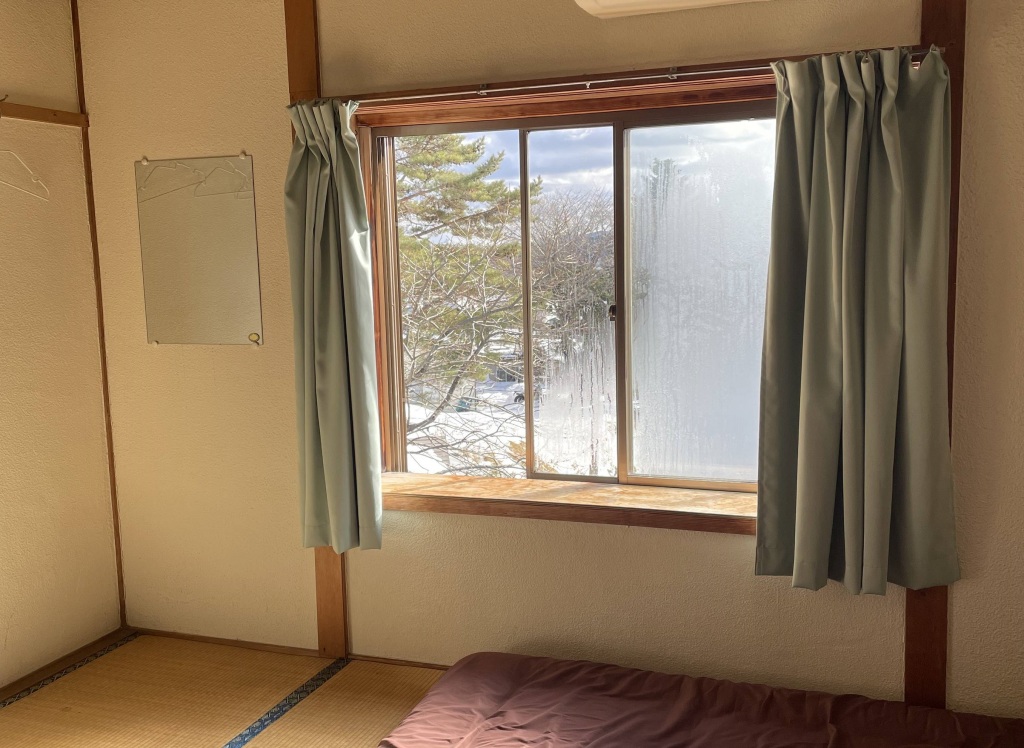
I share a Japanese-style room as well as the housekeeping duties with Adelina, a Russian-French woman. Shortly before 10 a.m., we peel ourselves out of the warm blankets and turn on the gas heater to warm up the room a little while we get dressed. Then it’s down to the work meeting with Natsuki. We divide up tasks A (shaking out futons, vacuuming, taking away used bed linen and cleaning toilets) and B (preparing futons for the new guests, preparing new bed linen, emptying garbage cans and refilling gas canisters for the heaters) between us. Natsuki lets us know who has already left and how many guests are expected in which room. Although check-out is not until 11 a.m., most of the guests have already left early.


And so we start by lugging vacuum cleaners and cleaning materials up the steep stairs to the second floor. In addition to our staff room, there are 3 tatami guest rooms for 3 to 4 people each, as well as a room with 4 bunk beds. The first thing we do is turn off the heating and air the room. Then Adelina starts to shake out the futons and pillows and store them in the cupboard provided. Meanwhile, I take care of the waste garbage cans, the contents of which have to be separated first. PET bottles, cans and glass bottles should be disposed of separately. In Kusatsu Onsen, plastic lids and any plastic labels must also be removed and disposed of in a plastic bag.


In the meantime, the first room has been completely cleared out and vacuumed. So I start by laying out the futons on the floor in the right order. I add 1 pillow, 1 eiderdown, 1 woolen blanket and 1 thin electrically heated mat. I lay out the bed linen on the table by the entrance for the guests to take if they wish. Then I close the windows and make my way to the next room. Adelina has almost finished with the shared toilets on the upper floor and then heads downstairs, where there is another mixed dormitory with 8 beds. Some of the guests there have also left and the futons and bed linen need to be changed.


For my last room task, I have to go outside into the icy Alpine air. Behind the house are the large canisters from which I use a plastic pump to transfer petrol to the aluminum containers of the electric radiators. I go up and down the stairs several times until all the canisters are filled. In the meantime, Adelina has also cleaned the downstairs toilet and vacuumed the entrance/lounge area and the kitchen. Because the guest house is located in an onsen resort, all guests and residents shower in the public bathhouses. There is therefore only one simple bathroom in the house, which is hardly ever used and therefore does not need to be cleaned. So it’s time for the grand finale: rebuilding the kotatsu.


The kotatsu is a heated table and essential in the rural areas of central Japan, where winter temperatures are around 0°C and houses are sparsely insulated. The first step is to lay an insulating mat on the freshly cleaned floor, silver side up. A thin fabric mat is placed over this and the low table frame with the electric heater is placed in the center. Seat cushions can be placed around the table as desired. A large, thick blanket is now draped over the table frame. This reaches down to the floor and over the cushions. Finally, the heavy table top is placed on top to hold the structure together.


Depending on the number of guests arriving and departing, Adelina and I can finish work in just 1.5 hours and sit down at the freshly prepared table for lunch. When you stretch your legs out under the kotatsu, you immediately feel warm and cozy. It is not only a source of warmth, but also a place to get together. During the day, it is used for tea with new arrivals, dinner, playing cards and drinking homemade umeshu.
If you want to read more stories about my experiences with HelpX in Malaysia, Hokkaido, or on an oyster farm: click here.
 thattravelstory
3 thoughts on “How I learned to set up a kotatsu”