Japan – February 2023
To make my stay in Japan at the beginning of 2023 as affordable as possible, I help out on an oyster farm in northern Kyoto in exchange for board and lodging. The owner family has been running a small inn in the annex overlooking Kumihama Bay for several decades. Winter is harvest time for oysters and snow crabs. The two rooms on the second floor are very busy, with a different party every weekend. On the first floor, there are bathrooms shared by guests and family, as well as a large tatami room. This is where dinner and breakfast are served.


But let’s start from the beginning. Many guests have been coming here for years. Some travel from Osaka, others even from Oita and Tokyo. One time it’s an Izakaya that is celebrating a company party and has invited all its employees. Then there are three cousins (over 80 years old) who travel together every year. And once, it’s a class reunion of a group of men in their prime. They all know the Toyoshima family personally and all come for the good food, the fresh air and a dip in the nearby Onsen.

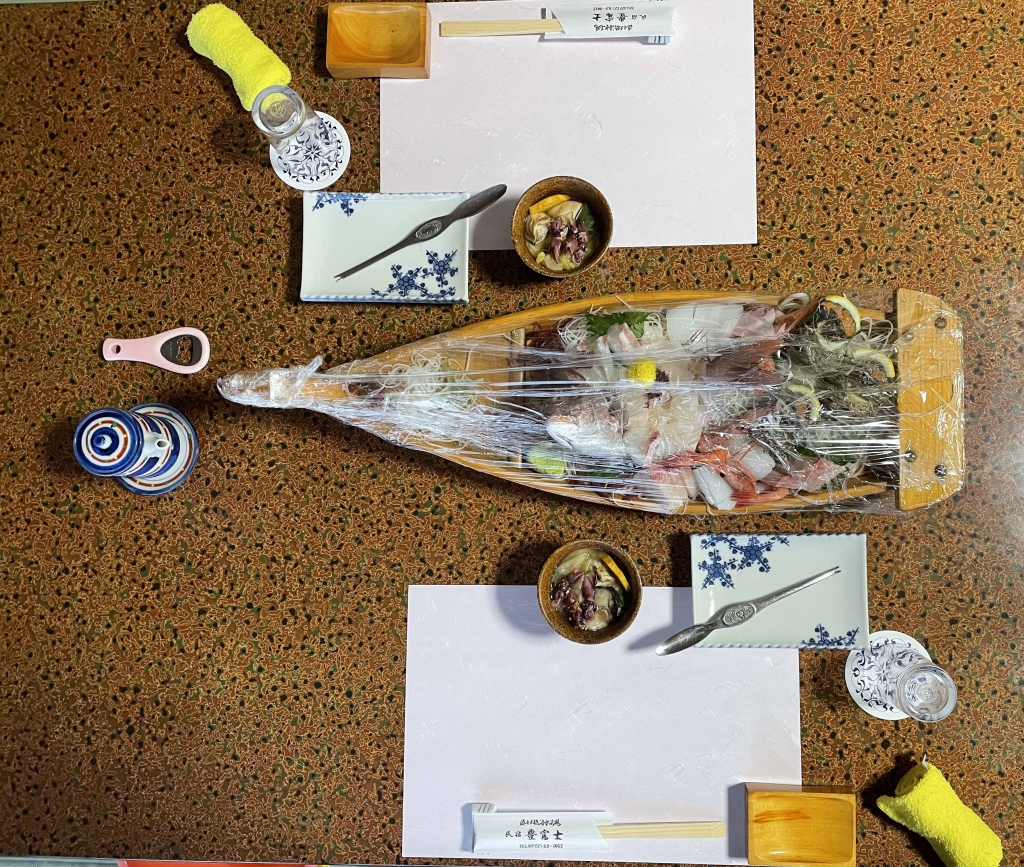
Depending on how the guests arrive, they are picked up by car at Shotenkyo station on Saturday afternoon. This means that, depending on the workload during the week, I start setting the tables and vacuuming the tatami mats on Friday or Saturday morning (I have already learned about this task in detail at Kusatsu Onsen). The first time, I make an effort to record the placement of the dishes with photos. Nevertheless, the washcloths dipped in warm water are forgotten in the second week.

In the early afternoon, I join Atsushi’s father in the kitchen. He shows me how to prepare the fresh oysters for frying. First they are laid out on kitchen paper and lightly dabbed before I dust them with flour. The oysters are then dipped in beaten egg and finally covered in panko. *If you use chopsticks for all the steps, it’s much cleaner. Because it is still quite cool in Kumihama in February, the prepared oysters can be stored in the fridge until the evening.

Shortly before the guests arrive, the sashimi boat is usually delivered. These are true masterpieces and the suppliers are always a little confused when I receive the boats in the kitchen. Atsushi and I spend the rest of the afternoon taking the crabs apart, cleaning them and preparing them for steaming. Atsushi’s father then takes care of this in the evening. After a short break, he usually calls me into the smaller kitchen at around 6 o’clock, from where I am now supposed to take the delicacies across the courtyard to the guest house.

I soon get the hang of opening the sliding door myself with my hands full. Then I take off my shoes as I step onto the wooden beam in front of the dining room. The guests are often already sitting on the soft cushions, chatting and turning their heads expectantly when I open the second sliding door. The reactions vary depending on the company: The Izakaya people laugh and ask in Japanese where I’m from. At another company event, there is a brief silence and a short conversation about whether anyone speaks English. The class meeting is already on its second round of sake and someone shows off their Swiss watch. Surprisingly, I find Atsushi’s father sitting at the table with the three cousins. He introduces me and immediately mentions that I speak 4 languages.


Each time I place the sashimi boats in the middle of the low tables and the large plate of steamed oysters between them. I then place a plate of hot prawns in front of each guest and, wherever there is room in between, another plate of fried oysters. By now the tables are full and the guests are delighted with the feast. I take drink orders as best I can and Atsushi’s daughter helps me carry them. We are constantly clearing empty plates and bowls and taking the pink garbage cans filled with crab and oyster shells to the kitchen.


The grand finale of the multi-course meal is not a dessert, but a large nabe pot filled with all kinds of vegetables and oysters – a real feast. While the guests are filling their bellies, this also means a short break for us. We dip the leftover fried oysters in a sauce of ketchup and mayo or sesame, depending on what we fancy. We also have a bowl of rice and one or two steamed oysters. The dozens of bowls are then washed and dried.


In between, I am sent back to the dining room to serve hot sake or something else. The guests celebrating the class reunion take this as an opportunity to take a group photo. However, I am not – as I first understand – supposed to stand behind the camera, but also be in the picture. Because one of the men is not in the photo, he stands next to me immediately afterward so that the two of us can take another photo. As most of the alcohol has already been consumed, this is the time when a few attempts are made to communicate in English.

On Sunday morning, after breakfast (prepared by Grandpa), the guests have to leave early. Then there’s another round of washing up and airing out the futons for me before I can enjoy the afternoon off. Depending on the appetite of the guests, the family is lucky and there is some hub left over. On some Sundays, the end of the week is celebrated with an oyster hot pot.
 thattravelstory
One thought on “Banquet “Minshuku-style””