Thailand – October 2022
If you want to visit the north of Thailand, you almost can’t avoid it. Pai is no longer an insider tip for people travelling to Chiang Mai. I only spend 2 nights in the tranquil tourist town. The day after my arrival, I go on a short excursion. My destination is a waterfall and a bamboo bridge. The walk takes longer than I expected in the heat, and I’m glad when a man offers me a lift on his motorbike on the last section. I sit on the back of the banana transport structure and off we go. The nice gentleman is Chinese by birth and speaks reasonable English. He drops me off at the waterfall, from where I continue on foot to the next attraction.


I enjoy the slow journey and the view of banana plantations and rice fields. The bamboo bridge turns out to be both a tourist magnet and a connecting path from the main road to a forest temple. I follow the monks to the end of the impressive construction made entirely of natural materials and take a short walk between the peaceful Buddhist temples. In the afternoon, I make my way back to Pai on foot and am promptly given two more rides by Thais on motorbikes.


The next day I want to go on to Mae Hong Son. There are far fewer tourists there. That’s why the minibuses to the western side of the national park are much less frequent. Another reason may be the almost 2000 hairpin bends on the route. Either way, all the seats are already sold. So I make my way to the market early in the morning, from where, according to the bus ticket seller, a yellow songthaew will “probably” be travelling the same route at 07:00.


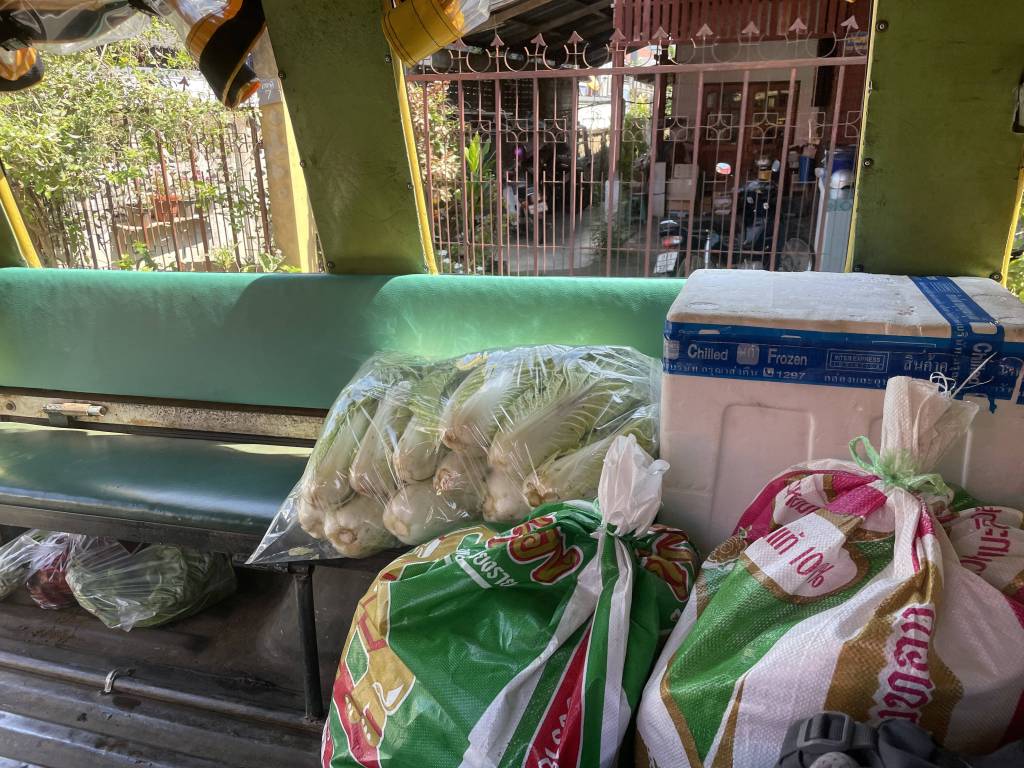
I’m lucky and the pick-up truck with the 2 benches on the back is ready to leave as I walk down Walking Street. With a few Thai women, a Korean woman and a lot of luggage and rice, which is attached to the roof, we set off just 30 minutes late. The 3-hour journey flies by. I enjoy the breeze and the view just as much as the sporadic stops when we pick up more passengers on the way, someone wants to get off or the driver unloads a delivery at a street market or someone wants to do some shopping.


Only when we are almost at the end of the line do I strike up a conversation with the other tourist. The Korean woman wants to go to Ban Rak Thai, a small village further up in the mountains. She has to change trains in Mae Hong Son. When we stop at the big market there, we find her next bus together. Once she has been taken care of, I organise a motorbike taxi for myself and – in true Southeast Asian backpacker style – sit behind the driver with my large rucksack on my back (and without a helmet). My destination for the day is the small village of Pha Bong. There I found the cute guesthouse called „Pimpa House“ online. Although it’s still before midday, Mr Pimpa lets me check in and even serves me a hearty breakfast, which I gobble down with a view of the rice field behind the house.


In the afternoon, I explore the small village on foot and come across another bamboo bridge. This one is a lot smaller, but also has some shady huts where I sit down with my book. I’m enjoying the peace and quiet of the rural area when suddenly a large group of visitors arrives. I am amazed to realise that the elegantly dressed crowd is probably a wedding party. The bamboo bridge now serves as a photo backdrop and I am trapped in my shady spot. Soon some of the grandmothers join me and ask where I’m from. They invite me to take part in the photo shoot and celebrations.


However, I am definitely not dressed well enough for this and thankfully decline. As the pack sings and dances goodbye, I watch the water buffalo return to its stall, enjoy the sunset behind the field and go to bed early. The next day begins with Mr Pimpa’s delicious breakfast and a chat with the other guests – a French family who are teaching their two children themselves during a one-year trip to Asia. As the kids start their maths lessons, I set off north on my bike. My destination is a Restaurant 10 kilometres away, which I have found on Google Maps.


What I didn’t expect, however, were the many hills along the way and the fact that my borrowed bike only has 1 gear. The tour drags on in the Thai heat and I am incredibly happy when the beautiful restaurant turns out to be even better than it looked in the photos. I polish off the good food and my Thai tea with milk at a table next to the koi pond and read my book for a while before setting off on the return journey. This time I no longer take the side roads through small villages, but take the main road. It’s now more downhill than uphill and I make fast progress. On the way, I buy something to eat for the evening at a roadside stall.


Somehow, after arriving in Mae Hong Son, I can’t stop thinking about the village where the Korean woman went. So I decide to make a short stop there on the way back to Pai. As the songthaew is running late on the day of my departure, Mr Pimpa takes me to the big market in town himself. He had to do something there anyway, so that would be fine. I thank him and then use my hands and feet to find the right yellow truck for my onward journey.


In foreign countries without a written timetable, it is important to inform as many people as possible at the bus stop about your destination. So I can leave my large rucksack at the bus stop without worrying while I get myself a cup of tea and some mango sticky rice. When I return, a Thai grandma points to my rucksack on the roof of a truck and tells me that this is my lift. And lo and behold. Just 20 minutes later I’m enjoying the breeze again on the winding roads heading north. Ban Rak Thai is about 60 kilometres from Mae Hong Son. But the driver seems to be in a hurry to get home, so we cover the mountainous route in just 50 minutes.


You can read the rest of the story about my surprising stay in the Chinese-style village on the Thai-Myanmar border in my last post.
 thattravelstory
3 thoughts on “The 1864 curves of the Mae Hong Son Loop”