Today I have a slightly different story for once. I’ve been writing a lot about Thailand over the last few weeks and it reminded me of my very first backpacking trip: alone from Mexico to Argentina. But of course, there are many more places in Latin America that I could have visited. Here we take a closer look at some of the best-known routes. *skip to the end for general tips & tricks.
The classic route along the West Coast
Colombia is the entry point for many travelers coming from North and Central America. The capital Bogotá is also well served by international flights to Europe. On the Caribbean coast, the beautiful colonial city of Cartagena awaits with long nights filled with the sounds of salsa and batchata. From here, both the paradise-like island of San Andres and the Tayrona National Park with its white sandy beaches are within easy reach.
The cities of Medellín and Bogotá are located in the interior of the country. In the former, a visit to the notorious Comuna 13 as part of a guided tour and a day trip to Guatapé are a must. In the capital, the Botero Museum and many murals can be found in the old town of La Candelaria. Another museum that provides information about the history of Colombia and the whole of South America is the Museo del Oro. Other highlights in Colombia are Cali, Popayán and Salento – the center of the coffee region.
The journey continues by plane or bus to Ecuador. Quito is the highest capital city in the world at an altitude of over 3000 meters. For backpackers, the Secret Gardens Hostel with its roof terrace is THE place to stay. In Baños (de Agua Santa), outdoor fans get their money’s worth: river rafting, ziplines and climbing the active volcano Cotopaxi provide an adrenaline rush. On the Pacific coast, Montañita promises partying and surfing. The Galapagos Islands are another highlight.
The next destination is Peru. The former center of the Inca Empire is well connected to the rest of America and Europe with international flights to Lima. The capital is often underestimated and is also suitable for longer stays (e.g. language school). From here you can reach Ica and the extraordinary oasis of Huacachina on a day trip. The hiking paradise of Huaraz and the northern Pacific coast with Trujillo and Huanchaco are easily accessible by bus. Here you will find the archaeological site of Chan Chan and waves that are perfect for surfing.
Another highlight for hikes lasting several days is the Colca Canyon near Arequipa and of course the Salkantay trek or the classic Inca Trail from Cusco to Machu Picchu. Instead of the 5-day hikes, you can also visit the ruins in the Peruvian Andes in comfort by train or on an adventurous bus ride followed by a shorter walk. Cusco also has an impressive historic old town with a large market. And finally, Iquitos should not be forgotten as the gateway to the Amazon.
Bolivia is also located in the Andes. On the border with Peru, you will find the charming town of Copacabana on the shores of Lake Titicaca. From here, you can take a day trip to the moon island “Isla de la Luna” and you can even spend the night on the sister island “Isla del Sol”. The minibus takes you on to La Paz. From here there are also great opportunities for day trips into the mountains at an altitude of over 5000 meters or down the Death Road on a mountain bike.
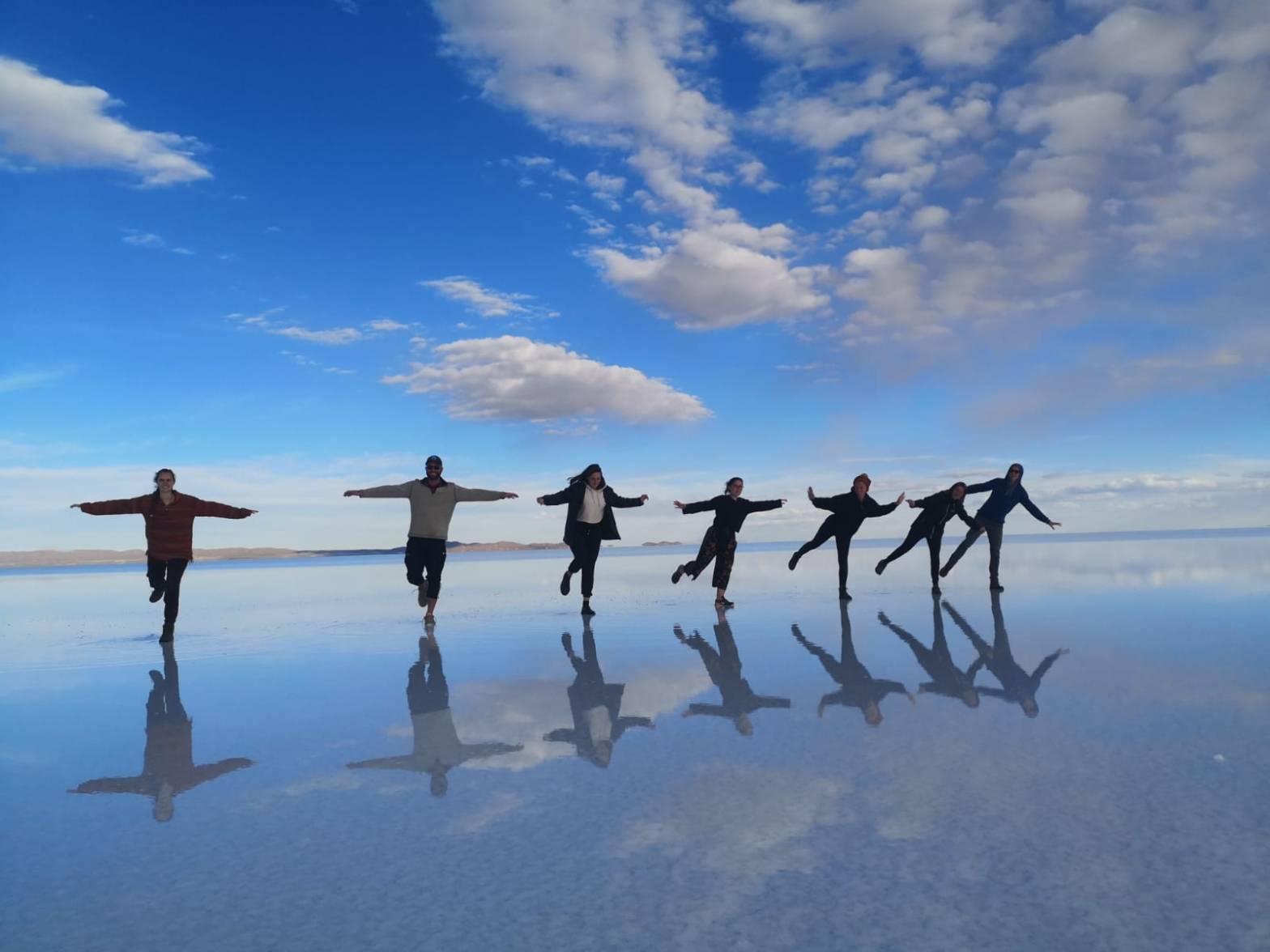
The east of the country also has a lot to offer, with the Amazon region bordering Brazil and Paraguay and the hidden gem of Samaipata. The small town lies on the road to the current capital Sucre. It is often the starting point for the journey south to Uyuni or Tarija, from where the famous salt lakes and the Atacama Desert are visited.
The 2-day drive through this same desert takes you to Chile. The highlight of the north is San Pedro de Atacama for excursions into the Valle de la Luna and the desert. From here, the quickest and most comfortable way to get to the capital is by plane. Santiago de Chile is also well-connected with international flights to North America and Europe. The coastal town of Valparaíso, known for its colorful houses, can also be reached in around an hour by bus.
A comfortable night bus takes you to the south. In the lake district around Puerto Montt in the north of Patagonia, you can visit the island of Chiloé, for example, or take a trip to Puerto Varas and the Osorno volcano. Other interesting places include the southernmost city in the country: Punta Arenas, from where you can set off on expeditions to Antarctica. Or the Easter Islands, which lie over 3500 kilometers from the coast in the South Pacific.
The Northeast, Brazil and Argentina
The north-east of South America has a lot to offer in terms of scenery. French Guiana, Suriname, Guyana and Venezuela are all located in the Amazon basin and boast beautiful sandy beaches on the Caribbean coast. However, for historical and political reasons, they are less well-known as travel destinations.
Brazil, on the other hand, is a popular travel destination in South America with several internationally connected airports and the world-famous carnival in Rio de Janeiro. One must-see attraction here is the 30-metre-high statue of Christ, which stands high above Rio. Further south of the country, on the border with Argentina and Paraguay, are the Iguazú Falls. Another well-known national park is Jericocoara in the north-east, which boasts miles of sand dunes and the best conditions for windsurfers. And finally, every trip to Brazil should include a stop in the Amazon. The main town in the rainforest region is Manaus.
The last country on the list is Argentina. Like many of its neighbors, this large country has a diverse natural environment and a lively capital. Buenos Aires is multicultural and ideally located for excursions to the Rio de la Plata region: Tigre and Colonia del Sacramento in Uruguay. In the northwest, on the border with Bolivia and Paraguay, are the provinces of Salta and Jujuy. Here you will find small, dusty villages such as Humahuaca, Tilcara and Cafayate between high, rocky peaks and cacti.
In Mendoza, the climate is more balanced and nature is somewhat greener. The Argentinian wine, much of which comes from here, is among the best in the world. Bariloche is even greener. Known as the “Switzerland of South America”, the region, characterized by lakes and mountains, enjoys four seasons and is ideal for hikers and winter sports enthusiasts. And then there is Patagonia in the far south. From December to February, the icy region with its numerous national parks invites you to hikes lasting several days and highlights such as a visit to El Chaltén.
Tips and tricks
- Public buses are comfortable & safe: that’s how the locals travel too. Tickets can simply be bought locally at the terminal.
- A basic knowledge of Spanish (and Portuguese) is recommended, but English is also perfectly feasible. As always: if you try to communicate in the local language, you will get much further and possibly even save money 😉
- Google Maps is a traveler’s best friend. With offline maps, you can get around even without the internet. MapsMe is also often used, but is sometimes a little less accurate
- For transport connections, both Rome2Rio and Busbud are reliable websites. However, you should always calculate a little more time.
- South America is still often considered dangerous by Europeans. In my experience, however, with a little common sense and an awareness of your own environment, you can usually travel very safely. This also includes listening to the locals when they say that a certain area is too dangerous at a certain time.
 thattravelstory