Argentina – May 2019
From Cafayate, I head back to Salta and from there on to the neighboring province of Jujuy. My destination is the most north-western region of Argentina, where, according to travel friends, you can see colorful limestone mountains. I enjoy the 2-hour drive from Salta to San Salvador de Jujuy through quiet villages from the front row on the top floor of the coach. After arriving in the small yet spacious city, I check into my accommodation in the center.


Then the search for dinner begins. The choice of restaurants is not very large and various places are closed. Then suddenly I’m drawn to a cake display case and find myself in a pizzeria. I choose a Hawaiian pizza and accept the waiter’s recommendation that 1/2 a pizza would definitely be enough for me. As you can see from the picture, the half pizza isn’t very big and I’m still hungry after the meal. Luckily, the delicious chocolate cake can provide a remedy.


After a cold autumn night in the hostel, the journey to the north continues the following morning. The 2-hour drive to Tilcara once again brings with it an impressive change of scenery. Green, wooded hills give way to desert characterized by cacti. The architecture of the small villages we pass is very similar to Cafayate, which is now 400 kilometers away. However, the inhabitants and the number of stray dogs remind me more of Bolivia, just 200 kilometers away.


Then the bus turns off the main road and crosses the bridge that leads into Tilcara. I get off at the bus terminal and spontaneously decide to book a room at the nearest hostel, which goes by the name of “El Farolito”. I leave my rucksack in the room facing the large garden and set off on a tour of discovery. The biggest attraction here is the Pucará, an archaeological site from pre-Columbian times. I am particularly impressed by the many cacti scattered around the ruins and the fantastic view. In the afternoon, I stroll through the small streets of the town before buying some snacks for lunch at the street stalls in the main square.


Then I play briefly with a little boy who is kicking an empty Coca Cola bottle around instead of a ball. He seems to be on his own, but none of the adults in the square show any concern. After a while, I say goodbye and head back to the hostel. In the meantime, more guests have arrived and after a short time I make plans for dinner with 2 Argentinians from Buenos Aires, 2 Frenchmen and 1 Belgian at Maté. We agree on barbecues and then head up the Puente Ferroviario to the hill, where we collect firewood.


It is a lively group and I switch between the different languages depending on who we are talking to and occasionally act as translator. The Argentines circle the maté and only when the fire slowly dies down do we feel the cold of the desert night. We realize that it’s time to go to bed. After all, I finally want to go to Humahuaca the next day to see the colorful mountains. The next morning, we say goodbye after breakfast and everyone sets off in different directions. My bus ride only takes 50 minutes and I arrive in Humahuaca at lunchtime. The town is just as dusty and characterized by square adobe houses as Tilcara.

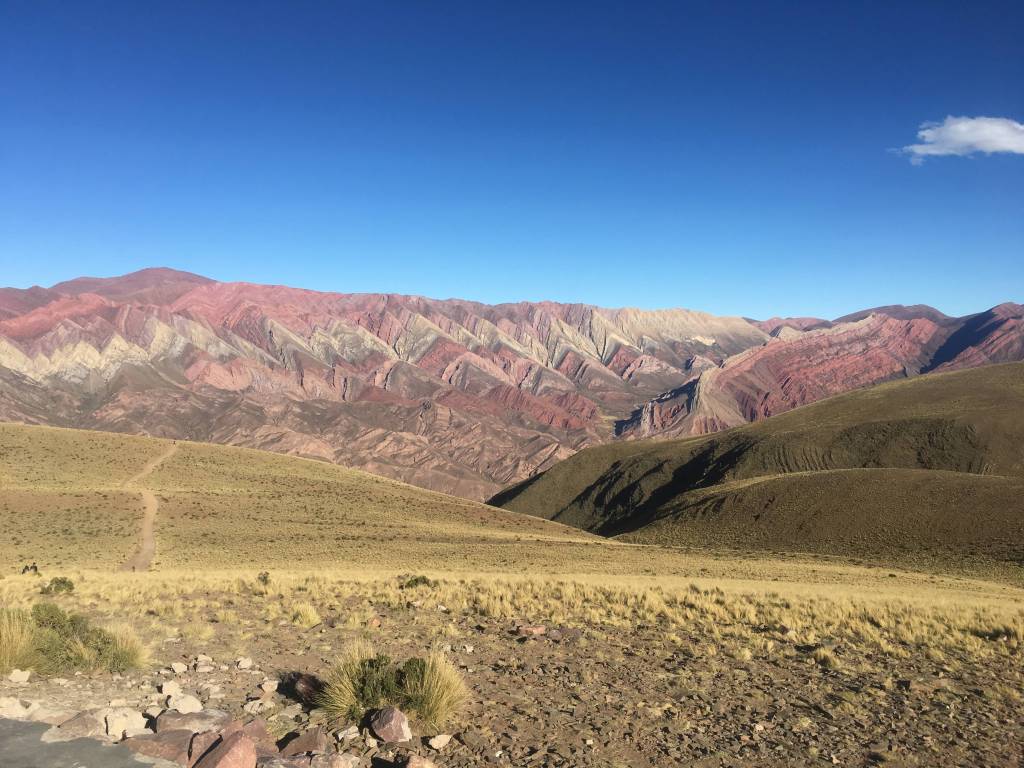
So I like it here straight away. I start looking for accommodation and then there is the arduous task of withdrawing money. In Argentina, this is a tedious task even in large cities due to inflation, but in small places like here, with only a few ATMs, it can take hours because of the waiting times. To my surprise, however, I find the Czech woman and the Israeli I met a few days earlier in Cafayate in the queue. They also want to go to the Hornocal today and so we are soon on our way to the infamous unofficial cab spot at the bridge. There we actually find a local with a pick-up truck who gives us a lift to the Sierras des Hornocal for a few dollars.


For a really good photo composition, however, it is essential that we walk down a good 500 meters from the first viewpoint to the lower viewpoint. That may not sound like much, but at over 4,300 meters it should not be underestimated. Of course, we only realize this when we make our way up to the parking lot after the photo session… But with a few breaks, we make it and find a lift back to the city a short time later. On the way, we meet one of the four-legged inhabitants of Humahuaca. In the evening, I set off for my last street food dinner in South America for the time being.


Unfortunately, the Sánguche de Bistec doesn’t mean well with me and I spend the night with stomach pains. Fortunately, the next morning I only have to take the direct bus to San Salvador de Jujuy, where I spend another night before returning to Buenos Aires by plane. I thought I would treat myself to a more relaxed journey for once, but the wind in the Andes has other plans. The flight is delayed by several hours and when we finally get on the plane, turbulence causes the devout Argentines to eagerly cross themselves and send prayers to heaven. At least I meet Gustavo from Jujuy during the wait, who gives me a lift to my accommodation in Buenos Aires.
 thattravelstory
One thought on “In search of the colored mountains”