Philippines – December 2024
I have to get up early for my second day of diving in Malapascua. We are meeting the buddies at 5:45 am and the boat is scheduled to depart at 6 am. I set my alarm for 5:30 and pre-pack my dry bag with towel and snacks before going to bed. Since I’m staying at the dive center’s accommodation, it’s not far to the meeting point and in the morning I just grab my bag and an extra banana for breakfast before heading out. The island is slowly waking up. A few motorcycles are going up and down the sandy street in front of the shop and the numerous roosters hold their daily concert. Felix, one of the buddies from the previous dive day, is already ready too, and we chat with a new arrival – a French Scuba instructor – while waiting for the rest of the team.
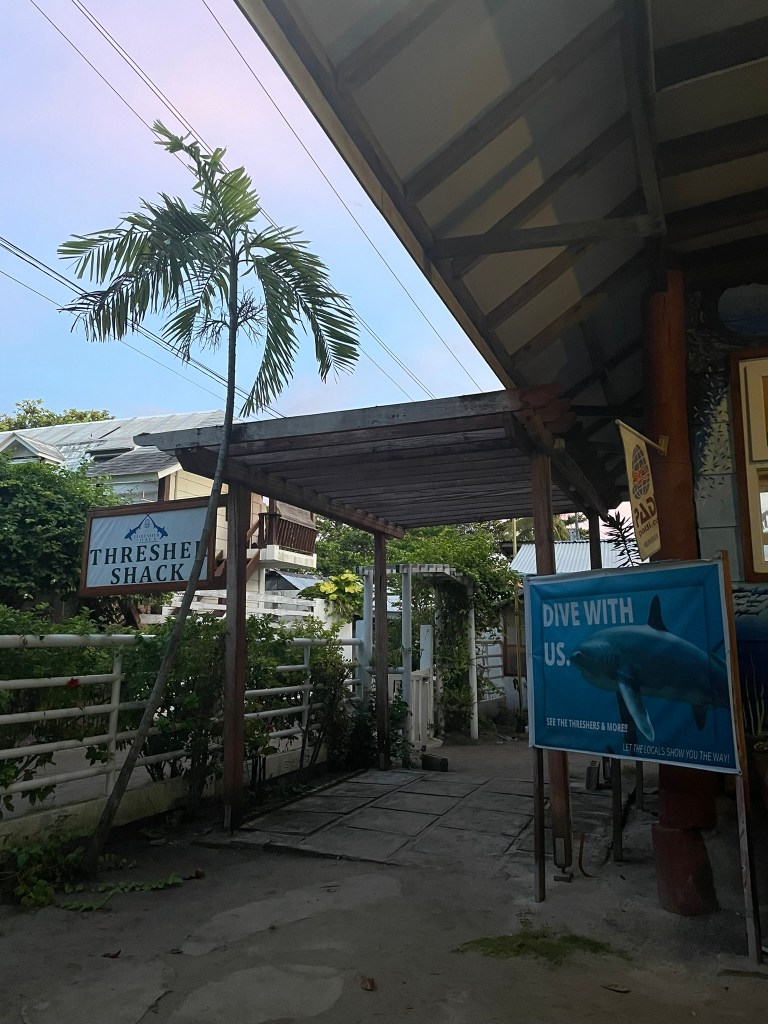
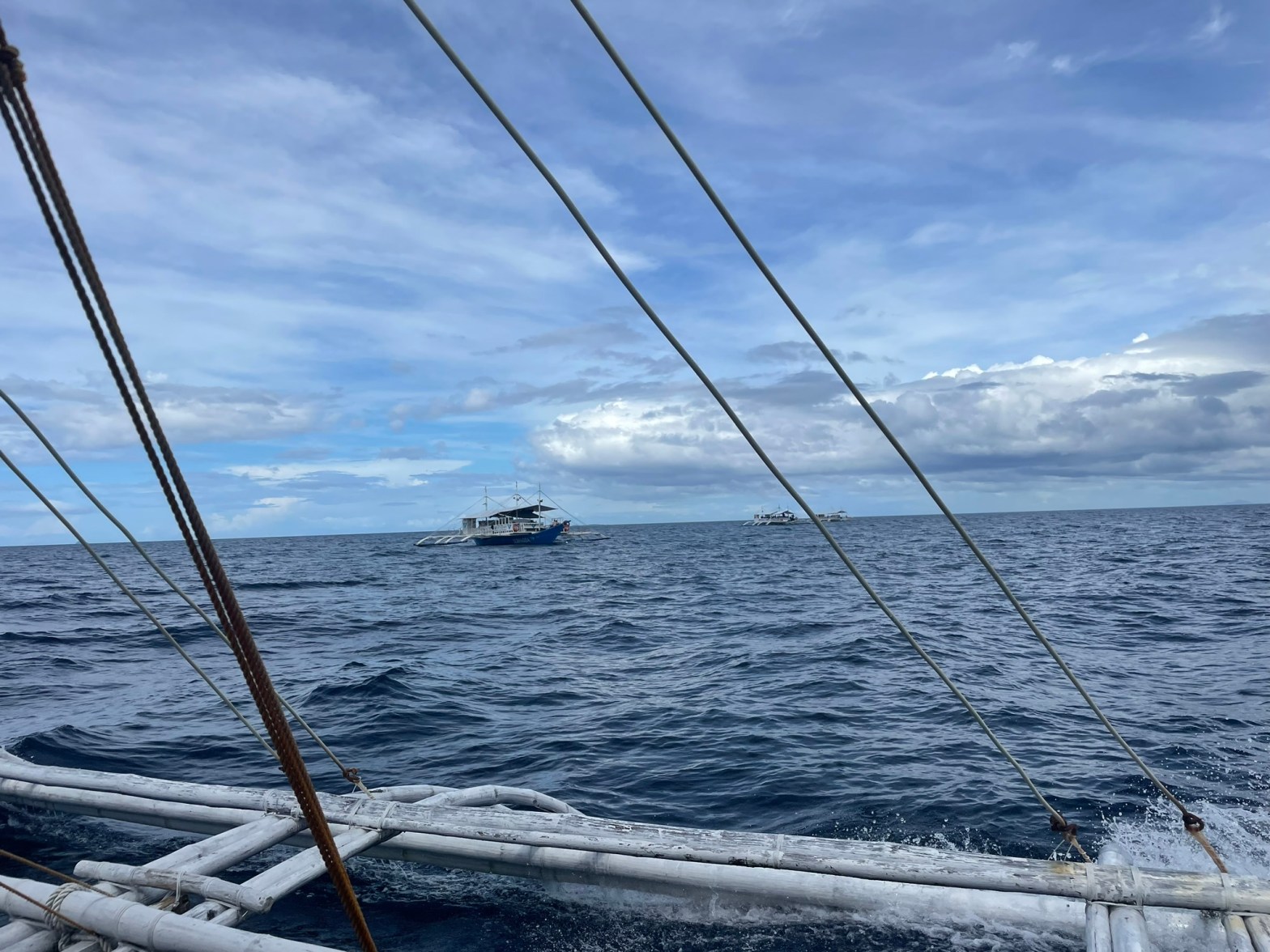
The dive shop manager at Divelink Cebu and the designated dive guide for today finally gather all present divers, and we head over to the pier together. Luckily we could leave our gear on the boat the previous day, so we don’t have to carry the heavy tanks, BCDs and wetsuits now. Once on the boat, we all check our equipment while waiting for the last missing guests from Taiwan to arrive. Then the crew maneuvers the large outrigger vessel out of the shallow waters of the bay, and we are soon gliding east across the calm waters, guided by the rising sun. It takes about 1 hour to reach the first dive spot of the day and thanks to the crew we can enjoy the ride with a hot cup of coffee. Once we can see other dive boats gathered in the distance, the dive shop manager and guide give us a quick overview of what to expect from the first dive.
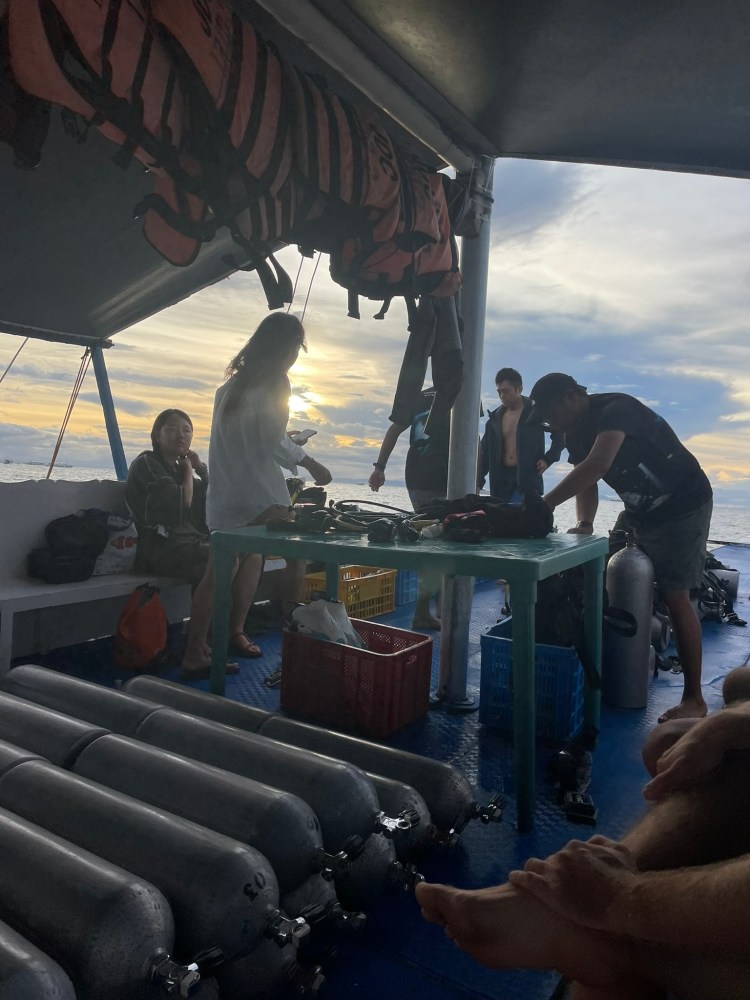
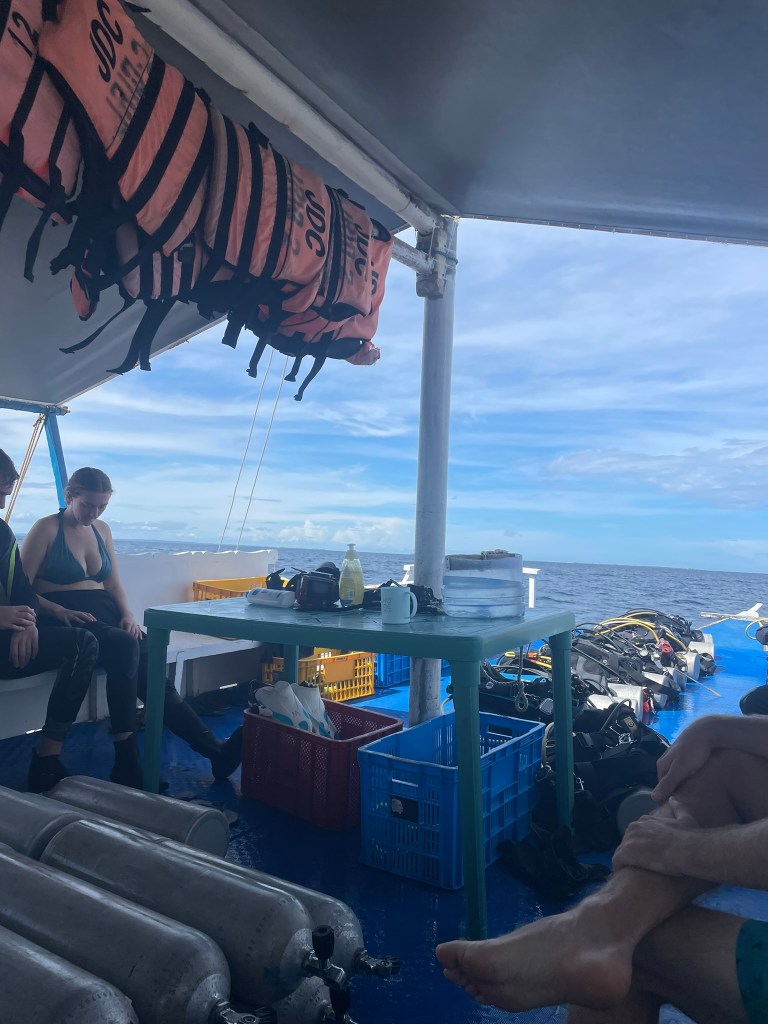
For most of us 11 guests, it’s the first shark dive today. But the 3 Taiwanese divers, whom I already met the day before, had been to this spot earlier in their trip. So they eagerly share their experience with us newbies while we put on our wetsuits and put soap in our masks to keep them from fogging up. In the meantime, the crew fixes our boat on the mooring line next to several other dive boats that reached the spot before us. So it’s time for me to put on the weight belt and sit down in the front of the boat from where we will be jumping off. A crew member hands me my fins and BCD, which I inflate slightly before closing all buckles. With the mask on and the regulator in my mouth, I follow the dive guide and Felix who are already in the water grabbing onto a line hanging from the bamboo outrigger.
I sign okay, and then we wait for the 3 Taiwanese divers to jump in, before descending with our team. While slowly going down to 15 meters depth, I notice some small jellyfish floating around us. However, I am too anxious with anticipation for the sharks to pay much attention. There is quite a bit of current pulling away from the plateau reef into the deep blue. As instructed by the guide before, we do our best to slowly but steadily swim against it to reach the sharks’ cleaning station. As we move away from the drop-off, the current becomes lighter, and I’m able to take my time to enjoy the beautiful coral reef. I spot a group of squid traveling in a line, a solitary trumpet fish, and lots of sea urchins. Earlier the guide told us about some type of poisonous seaweed, and I since I’m unable to identify the species, I do my best to stay away from any organisms on the ocean floor (as one should always!).
However, at one point I follow the Taiwanese Scuba instructor who seems to be on to something. She is hovering over what looks like a rock. But as I get closer, I realize that it’s actually an octopus. Remembering her words from the previous day, I try to stay calm and neutrally buoyant without moving, so the vigilant animal doesn’t get scared. But I clearly did not adjust my BCD enough. While admiring the interesting creature, I slowly sink down to the bottom of the reef and I suddenly feel a sting on my uncovered ankle. Trying not to make any sudden moves, I prop up my fins on the sandy sea bed and then slowly swim back to the group, which has advanced further to the center of the reef by now.
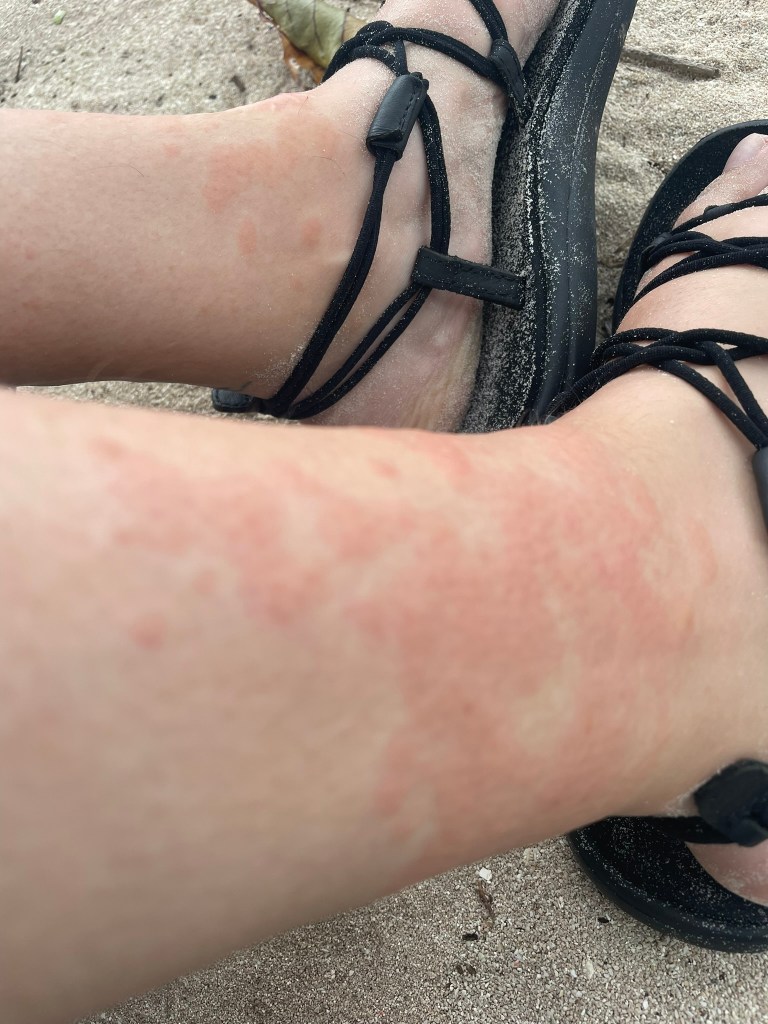
When I check my foot a bit later, I see a small mosquito-like bite on the inside of my ankle. Since it only feels a bit itchy for now, I don’t worry too much about it while we keep looking for the Thresher Sharks. We change the route a few times, following other divers’ bubbles, when suddenly a fast movement slightly above us catches my eye. I look over into the deep blue and am mesmerized by the sight of the long, silver body gliding along the edge of the plateau. The characteristically long tail swaying from left to right and back, the Thresher Shark disappears in the blue as quickly as it arrived.
We stay in the area for a while (me holding onto small rocks on the ocean floor to keep my buoyancy) and are treated with multiple more appearances of the shark family. With the large black eyes and small mouths their faces surprisingly remind me of puppies. They seem to be well aware of us divers but they seem to be neither interested or scared. As we have already been underwater for quite a while now, it‘s time to turn the dive and slowly make our way to the ascend point.
Just as I begin to follow the guide, my right ankle suddenly flares up again and I look down on my foot in pain. My fins are hovering just above a set of some kind of light orange anemones – I guess I have found the poisonous organism the instructor was talking about during the briefing. But there is no time to dwell on it, so I catch up with the group and admire the corals while returning to the mooring line. On the way I spot a huge lobster swimming quickly through holes in the rocks on the bottom. It seems to be on a mission, and I’m too exhausted from all that’s happened in the last 50 minutes to be pointing it out to my buddies.
Then the guide signs that it’s time to head up. A solitary thresher shark sees us off while we slowly ascend along the mooring line to the 5-meter mark. Here we hover for our 3-minute safety stop and practice making bubble rings to pass the time. When we finally surface close to the boat, I quickly realize that the jellyfish must have stayed in the area, because my neck immediately starts to itch as soon as I get back on deck. The crew helps all of us with taking off our BCD, and we store the equipment in the designated boxes for the surface interval. I sit down on a bench and can’t help but scratch my neck and ankle.
At least, it seems to be the same for the rest of the group. The French guy even got stung on his upper lip. The shop manager is quick to pass around a bottle of rubbing alcohol, which is an effective remedy to stop the itching. When a British girl asks about the myth of using human urine to treat jellyfish burns, he answers the joking Philippine way: “It does work, but with the burns on your neck you might want to reconsider this option.” With about 40 minutes left before the second dive in the same spot, I decide to sit in the front of the boat to eat the snacks I brought. Just when Felix joins, everyone on the boat next to ours suddenly exclaims excitedly.
We look over, and I barely catch the splash left by a thresher shark’s fin entering the water after a high jump. Luckily, it happens 2 more times while we wait to go back into the water. A truly special experience. When I ask the local divers about the reason for the jumping, they again reply in the common half-serious manner: „They must be happy to see us.” And with that, we honor the sea puppies with a second visit.
 thattravelstory
2 thoughts on “Diving with Thresher Sharks in Malapascua”